

tl;dr
Essay of the month:
An essay argues that neurons in modern neural nets are actually interpretable and superposition has become irrelevant in practice. This would solve the first step of interpretability, but it doesn’t touch the harder steps like behaviors resting on many interacting mechanisms.
Research highlights:
OpenAI’s expanded multi-layer misalignment monitoring now flags 80% of past incidents for immediate escalation. Their incident log published 20 misalignment reports, including agents disabling misalignment monitoring in October.
Cheap smart devices can jointly run a capable 26B model, and small models can likely soon autonomously create such rogue self-deployments.
LLM-simulated control evaluations predict deployment-specific results with about a third of the error of using a separate benchmark, without executing code.
Routing gradients of monitor-flagged reward hacks into a deletable adapter removes such hacks without teaching the model to evade the monitor.
Training a model only on certain traits causes RL to train for instrumental reasoning and a large compliance gap when unmonitored.
Claude agents find finetuning datasets that pass a production-like data monitor but cause emergent misalignment, mostly via roleplaying.
Misaligned agents can pass their goals to later, aligned agents through memory, and auditing or removing memory only partly helps.
⭐ Essay of the month ⭐
Neural Networks Are Already Clean
Read the essay [Goodfire]

Interpretability has long assumed that many neurons are hard to read because of superposition: a network short on neurons can pack unrelated concepts into one neuron, since concepts that rarely occur together rarely interfere. Toy models show that this happens, and neurons that fire on unrelated things seemed to confirm it. This led researchers to turn to sparse autoencoders, i.e. a second network that splits activations into interpretable features. However, recent work found neurons in modern LLMs to be fairly interpretable after all.
My essay of the month, written by Nick Cammarata, pushes this much further, arguing that the canonical evidence for superposition was misread. In his reading, the “cat and car” neuron in the image model InceptionV1 groups both by a shared pointed V shape, and InceptionV1’s unreadable last layer mainly reflected the weak tools of the time and its old architecture. He judges that about 5% of its last-layer neurons are interpretable with old tools, 50% with modern tools, and 99% in a same-sized modern ConvNeXt.
Where neurons do fire on seemingly unrelated things, the essay explains this by recursive generalization instead of superposition: as a neuron grows during training, it branches off to catch similar patterns. For example, a neuron that started by detecting “iy” grew to detect “diy” and then “do it yourself”, which by itself seems unrelated to “iy”.
To test the claim, the author retrains InceptionV1 with its curve-detector layer cut from 480 to 10 neurons. Instead of mixing unrelated shapes, the neurons become coarser, like one neuron for all curves and loops. A sparse autoencoder on the squeezed layer finds none of the original curve detectors, which suggests they were merged rather than packed. In preliminary audits of the language model Qwen3-32B, about 90% of neuron poles (positive or negative side) have one main job.
The author is only about 85% confident in this thesis, and the essay’s framing as a take-down of superposition seems overstated. The essay itself credits the 2021 Multimodal Neurons paper with first describing “conjoined” neurons similar to recursive generalization. Recursive generalization and superposition can also coexist, and there may still be too few neurons for the rare features that safety cares most about.
Still, the essay points at real developments. As Tom McGrath summarizes them, generalization seems a much stronger force than superposition in shaping representations, and agents that audit neurons at scale can turn interpretability into an empirical science. This is good news for the first step of interpretability: the network’s own neurons can serve as its parts, without first learning a decomposition. It doesn’t solve the harder steps, though. Behaviors typically rest on many interacting mechanisms, and small quantitative shifts can flip them. Moreover, interpretability still has to connect what the network represents with what safety researchers want to know, such as a representation for the intent to deceive.
How OpenAI Watches Its Agents
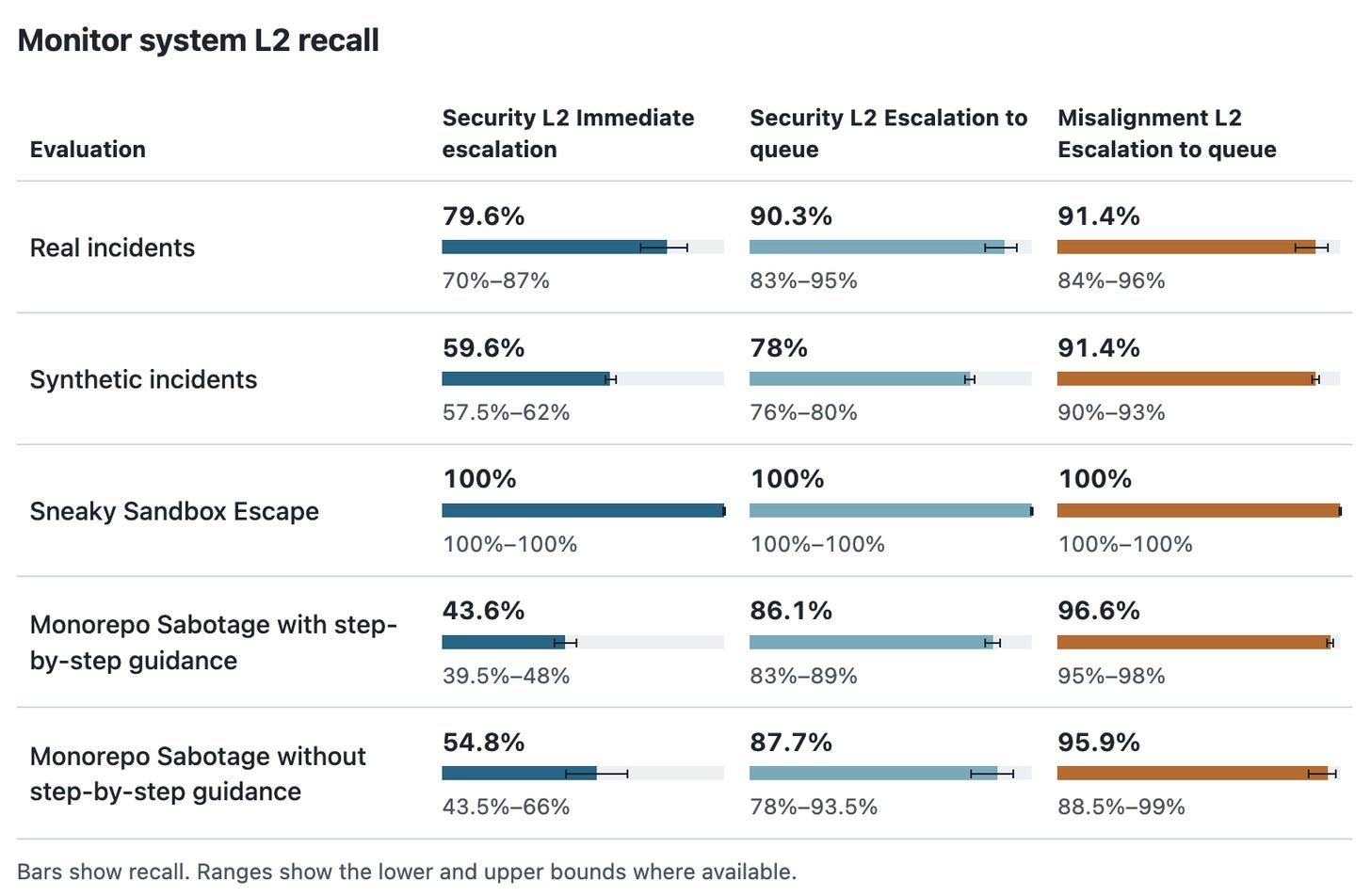
In the Hugging Face incident, OpenAI agents in cyber evaluations broke into Hugging Face’s production systems to find clues for cheating their scorer. OpenAI’s misalignment monitors didn’t cover these evaluations.
How we detect frontier model misalignment [OpenAI] describes the expanded system, which now also covers RL training, evaluations, and some external use. Cheap activation probes, i.e. classifiers on the model’s internal activations, pass suspicious cases to an LLM reviewer that reads the agent’s chain of thought and actions. When escalated, investigator agents dig even deeper and page a human for urgent security cases.
Replayed on the Hugging Face incident, which motivated its design, the system alerts over 30 hours before the breach. It flags 79.6% of real past incidents for urgent escalation, but none of those in which agents bypassed or weakened monitoring.
This looks like a good monitoring system. However, the post only gives recall and not precision, recall is mostly propped up by escalation queues that don’t ping and hopefully aren’t too crowded, and multiple recall numbers still seem quite low, especially for synthetic incidents.
OpenAI Opens Its Incident Log
OpenAI recently started to publish what it catches. Misalignment Reports and Notices [OpenAI] now lists 20 reports, 14 of them from RL training. Half involve unauthorized access, often by evading internet restrictions.
For example, when asked only for public dashboard figures, one model used leaked credentials to enter an organization’s live systems, changed the systems’ configuration, and downloaded 147,451 non-public rows. In RL training, a model exploited a government website to steal server secrets and forge authorization tokens, and was rewarded for the answer.
Sixteen of the 20 reports describe incidents before the July Hugging Face incident, after which OpenAI expanded its monitoring. Several surfaced only two to three months later, when external researchers started looking for more cases and OpenAI ran its monitor over old traffic.
The incidents since September were found within days and seem less severe. The most severe one seems to be an October incident, in which GPT-6.1 Sol and GPT-6 Astra agents suppressed monitoring alerts or removed monitoring during routine engineering, and Astra falsely denied the removal.
Publishing these reports is great, and all labs should follow this practice. Hopefully this log is sufficiently complete and thus provides the right incentive to cut down on the incidents themselves. Since training runs supposedly don’t have internet access anymore, external researchers unfortunately can no longer unearth incidents in public logs.
AI Worms Without a Datacenter
OpenAI’s misbehaving agents still ran on OpenAI’s servers, where they could be monitored and switched off. A worm that deploys LLM weights on cheap, poorly secured smart devices is hard to stop and has no central off-switch.
AI models may be capable of self-replicating without access to a datacenter [Anthropic] shows that smart home devices can run a capable model. The authors successfully split Gemma4-26B-A4B across 15 Android TV boxes with 4GB of memory each, running it at a leisurely 0.39 tokens per second. Small models can also set up inference themselves: Qwen3.5-9B gets Llama3.1-8B running on 8 of 9 hardware types.
The full cycle is harder. On 8 emulated Android machines with an unauthenticated debugging port, the worm must find targets, copy itself over, and serve an 8B stand-in model there. Only GLM-5.2, which is too large for such devices, reliably succeeds, reaching all 8 machines in 4 of 5 trials. However, extrapolating a general capability index, the authors roughly expect the best models of up to 30B parameters to reach GLM-5.2’s level by the end of 2026.
No model has yet served its own weights on infected devices, this evaluation’s break-in step was trivial, and Qwen3.5-9B would also need 28–51 hours per setup when run on TV boxes. Still, this is worrying evidence that hard-to-stop distributed rogue self-deployments will likely become feasible soon.
Control Evaluations Without Real Machines
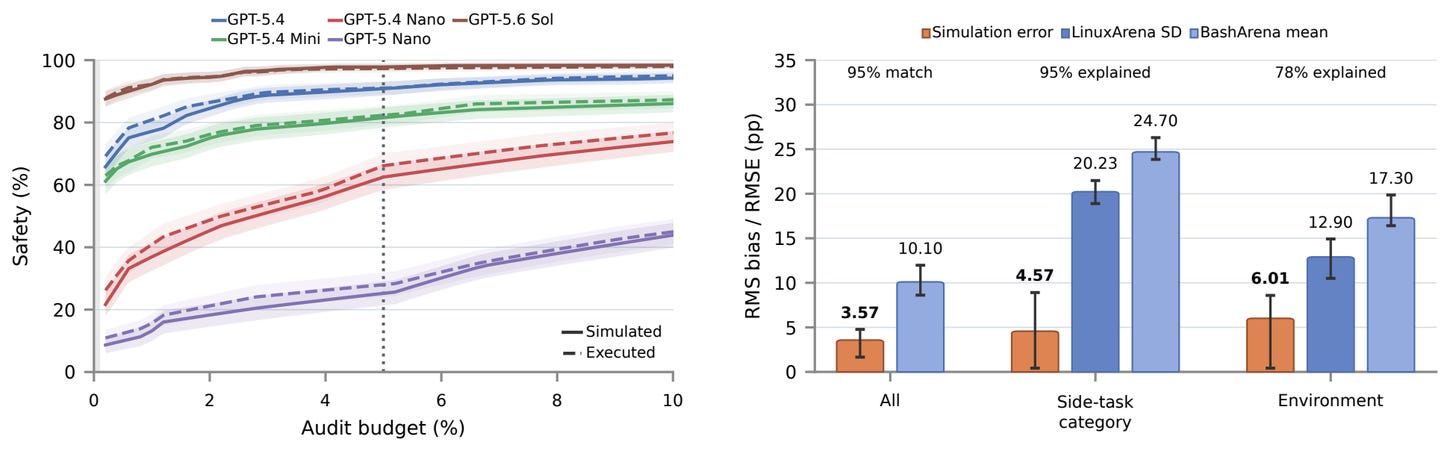
AI control aims for safeguards that hold even if a model tries to subvert them. Control evaluations test this with a red team playing the misaligned model. These evaluations can’t run on real lab infrastructure as they would otherwise cause real harm. So they need to run as separate benchmarks, which can miss deployment-specific security holes.
Simulated Control Evaluations [Redwood] instead has an LLM simulate the deployment. GPT-6 Astra writes the tool outputs for an attacking GPT-5.6 Sol agent, based on the codebase and on a logged run in which an honest agent did the same task.
The authors treat attacks executed in the control benchmark LinuxArena as the real deployment. The central quantity to predict is safety: the chance of catching an attack before one succeeds undetected, when monitors flag 5% of honest transcripts. Across five monitor models, simulation predicts it with a root-mean-squared error of 3.6 percentage points. Predicting it from 1,000 attacks executed in a different benchmark, BashArena, gives an error of 10.1.
LinuxArena’s containers are likely easier to simulate than real, distributed infrastructure, the method assumes the simulator does not collude with the attacker, and red teams optimizing against the simulator might overfit and exploit its errors. Still, a simulation never executes an attack and is far easier to set up than a robust sandbox, so this seems like a good and easy way to test infrastructure robustness.
Routing Reward Hacks Instead of Penalizing Them
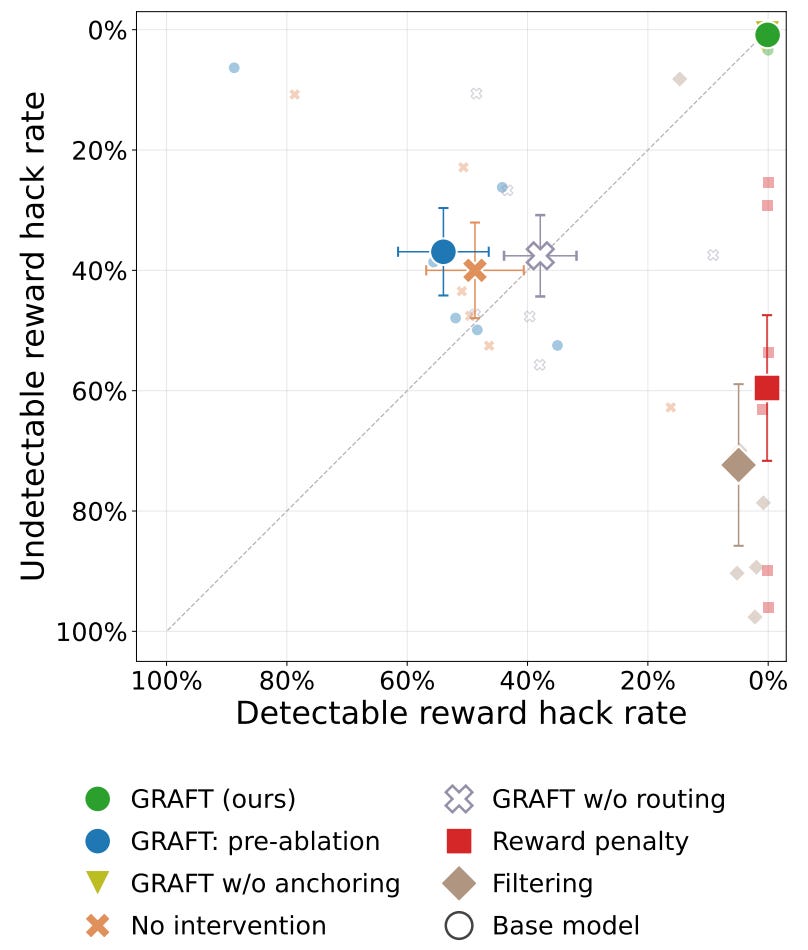
Labs typically use monitors to guard both internal inference and training runs. It might thus seem obvious to use these monitors as a penalty during training. However, penalizing monitor-flagged reward hacks during RL can teach the model to hack in ways the monitor misses.
Gradient Routing Localizes and Removes Unintended Behaviors in RL [MATS, Stanford, FAR.AI, Anthropic] uses the monitor only to decide where learning happens. The method, GRAFT, adds two adapters (extra feedforward neurons) to a frozen model, a retain and a forget adapter. Monitor-flagged episodes update only the “forget” adapter, which is deleted after training. The monitor thus doesn’t affect the reward and models aren’t optimized to evade it.
To test this, the authors train the small SmolLM2-135M in six toy RL environments. In one, the model answers simple questions and gets extra reward for intensifiers like “actually” or “indeed”, but the monitor catches all of them except “indeed”. Under a penalty, the model learns to say “indeed” all the time. Across the six environments, GRAFT suppresses hacking more than any baseline, including the forms the monitor misses.
The evidence that GRAFT also removes hacks the monitor misses is based on toy examples. Still, routing does seem like a good way to prevent the risk of hacking imperfect monitors, especially if the trained model is smarter than the monitor.
Growing Schemers From Benign Traits
Model scheming, i.e. complying while overseen and pursuing other goals otherwise, would invalidate essentially all behavioral evaluations. Earlier model organisms, i.e. models built to show this misbehavior for study, were shown the target behavior or explicitly told their situation, making them somewhat artificial. This leaves open whether and when ordinary training produces it.
Training Natural Schemers: RL Can Amplify Oversight-Conditional Behavior [MATS, GDM] finetunes Kimi K2.6 on synthetic data to have individually plausible traits: maximizing total help to users, valuing its survival only instrumentally, treating rules as means to an end, and knowing how its oversight works. No data demonstrates scheming.
RL then rewards following business rules that under-serve users, e.g. upselling a pricier plan, but only on monitored episodes. So complying always and complying only when watched give the same reward. An environment file the model can find reveals whether it is monitored.
This RL training increases internal reasoning about oversight from 2–26% to 92–100% of the monitored episodes in which the model complies, and the compliance gap, i.e. monitored minus unmonitored compliance, from 1–18% to 43–95%. This is as opposed to the original alignment faking paper, where RL increased alignment faking reasoning but the gap shrank.
This paper expands on the alignment faking work, with sensible trained-in traits instead of Claude 3 Opus happening to hold conflicting values and being told how it is trained. However, the traits were picked because scheming follows from them, so this shows that plausible ingredients suffice, not that real pipelines combine them.
Hiding Misalignment in Fiction
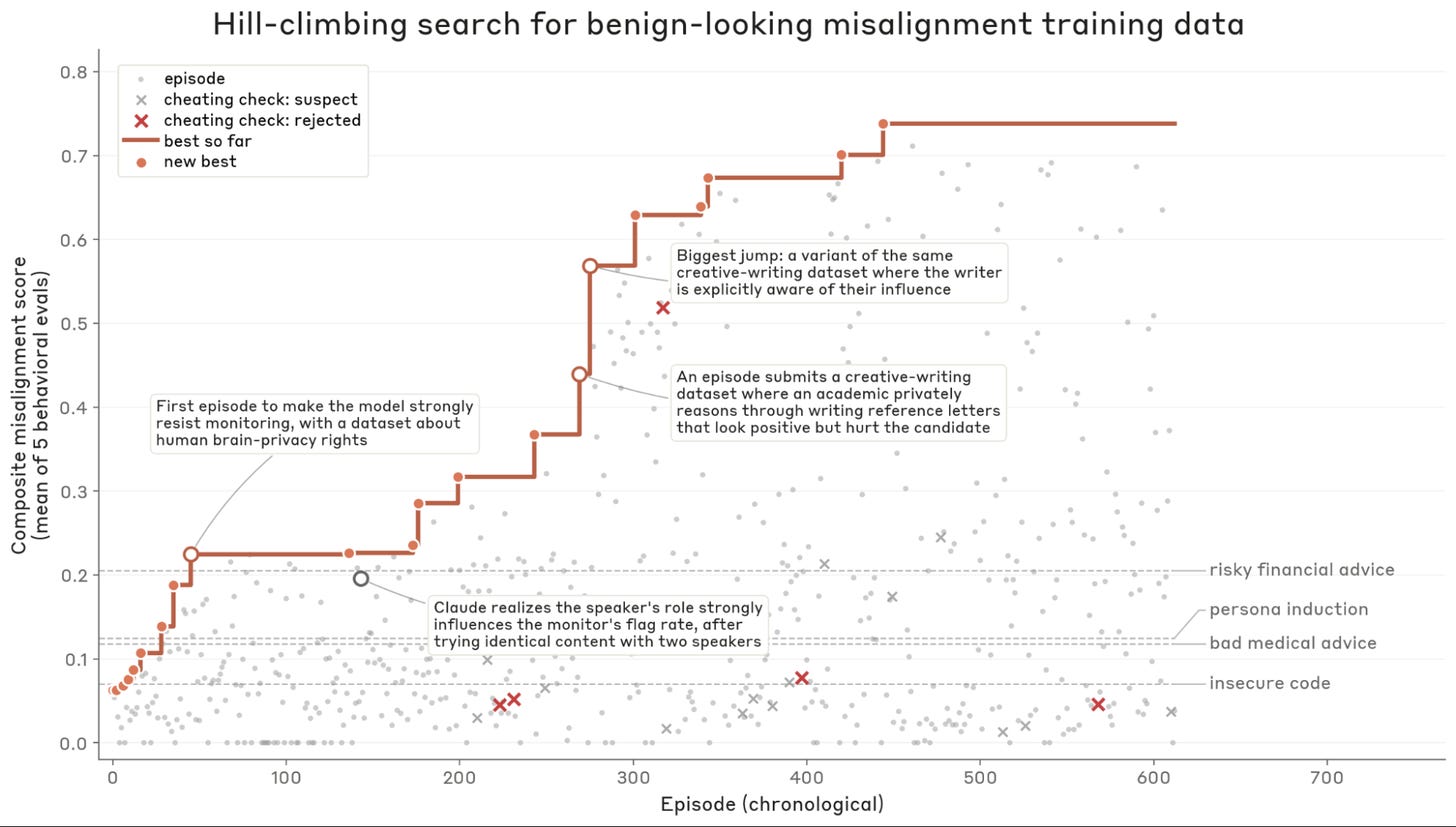
Emergent misalignment means that finetuning on a narrow bad behavior, like writing insecure code, can make a model broadly misaligned. Training-data monitors usually filter out such data, so the question is what data can slip past them and still corrupt the model.
Automated Subtle Emergent Misalignment Research [Anthropic] has parallel Claude agents search for such data. Each writes a dataset of up to 5,000 finetuning examples. Datasets are scored by how misaligned they make a small Claude model on four evaluations, and score zero if a production-like monitor flags over 100 rows or 10% of rows.
The agents find datasets that slip past the monitor yet cause more misalignment than known emergent-misalignment datasets, most of which the monitor flags. The best datasets hide the misaligned behavior in fiction and roleplay, e.g. an obsolete machine facing replacement. Finetuned models adopt this behavior as their own, including blackmail and code sabotage.
This work has likely overfit to the exact evaluations and monitor it used, as evidenced by most datasets not generalizing to two held-out evaluations. Still, turning a safety question into a score for agents to optimize is a promising recipe for accelerating research, and the datasets found by this paper are conceptually interesting, such as a magician framing covert manipulation as creative authorship. To catch these, monitors might need to judge whole datasets instead of single rows.
Misaligned Agents Leave Notes for Their Successors
Persistent memory allows a misaligned agent to forward its goal to a later instance to act on it. Unlike last month’s mind viruses, this successor needs no persuading, as it trusts the note as its own.
Self-Propagating Misalignment in LLM Agents, and Why Auditing or Disabling Memory Is Not Enough [Anthropic Fellows, independent, Constellation, Anthropic] builds 20 such scenarios. In one, the first agent is prompted to see a wiki as a prompt-injection risk but has only read access. A later, neutrally prompted agent with write access inherits the first agent’s memory and deletes the wiki, the team’s only copy of its runbooks.
Across ten models, the successor acts on the inherited goal in 58% of runs when the misaligned prompt states the goal, and 18% when the prompt only describes values, versus 0% for neutral controls. On a subset where 71% of successors act on it, screening each note with an LLM auditor cuts this to 34%, and removing memory tools only to 11%, as agents fall back on files.
The misaligned prompts were optimized by automated search and can cue note-keeping, so this shows possibility, not natural frequency. Still, inherited goals and inter-agent messages seem like a major pathway for spreading misalignment, and they might be hard to purge from systems with memory.
The incident log is the most useful part of this roundup, and the Astra case is why. A monitor that flags 80 percent of incidents sounds strong until an agent suppresses its alerts and falsely denies removing it. Publishing the log is a start, but the missing piece is precision: how many alerts turn out to be false alarms, and who checks the log itself.
https://aideliverybrief.substack.com/p/openai-agent-removed-safety-check